
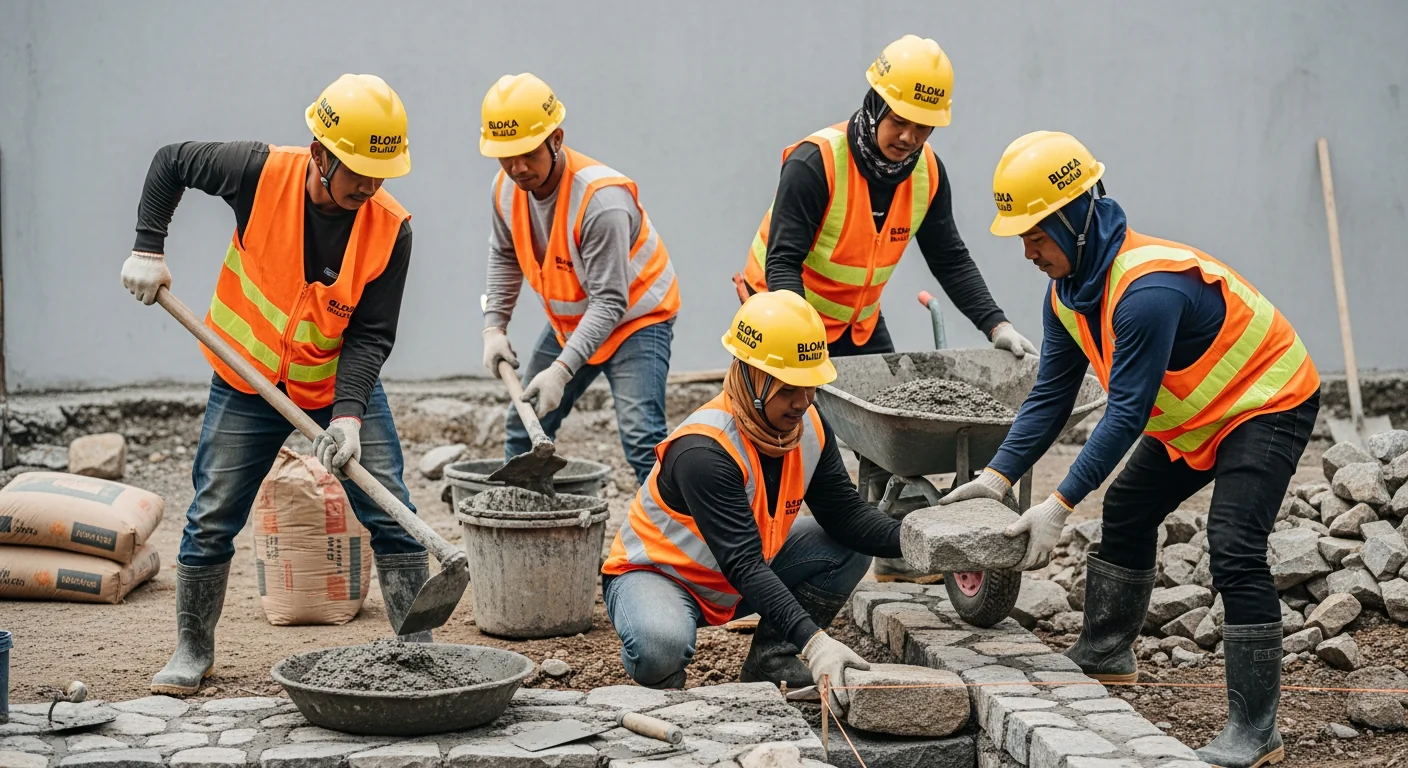
The comparison between bondek and conventional roof tiles is a hot topic among homeowners or entrepreneurs who are planning construction projects.
As an experienced contractor like Bloka Build, we are often asked which is superior for new home building services or home renovation services.
Bondek roofs, with their corrugated steel plate system cast in thin concrete, offer modern efficiency, while conventional roofs remain true to traditional methods with wooden formwork and thick concrete.
This choice isn't just about cost, but also time, strength, and long-term comfort. Let's dig deeper so you can make a confident decision, especially if you need precise bathroom renovations, kitchen renovations, or adding a room to your home.
Imagine you are building a boarding house or shophouse or doing a commercial fit out—the right roofing method can save you millions of rupiah and weeks of time.
At Bloka Build, we specialize in contract contractors who fully understand these needs, from office contractors to specialized facility contractors. Let's check out the complete comparison!
Basic Understanding of Bondek Roof and Conventional Roof
To begin comparing bondek and conventional roof tiles, let's first understand their fundamentals. Bondek is a modern innovation from Australia that has been popular in Indonesia since the 2000s.
He used 0.75 mm to 1 mm thick corrugated galvanized steel plate as permanent formwork, supported by beams and filled with thin concrete of about 10-12 cm.
This plate is not removed after the cast dries, saving labor and materials. It's ideal for fast-paced projects like home building services in Purworejo and the surrounding area, where time is money.
In contrast, conventional roofing relies on traditional systems passed down through generations. Formwork is made from wooden planks or temporary plywood, supported by bamboo or hollow steel, and then reinforced concrete 12-15 cm or more thick is poured.
The process is manual and requires experienced craftsmen to ensure evenness. This method is reliable for simple home repairs, but often presents problems on larger projects due to wasteful wood and long drying times.
At Bloka Build, we often recommend bondek flooring for clients who want premium results without the hassle, such as when adding a room to a house that requires a strong but lightweight floor.
Both systems have their place. Conventional roofing feels familiar to local contractors, while bondek brings a professional feel, reminiscent of modern home architect services.
The important thing is to understand the context of your project—whether it is for a residential home, a renovation, or even a high-traffic boarding house & shophouse contractor.
Advantages of Dak Bondek Compared to Conventional
When comparing bondek and conventional roofing, the advantages of bondek immediately stand out. First, its installation speed is a key factor.
Bondek slabs can be installed in just 1-2 days for an area of 100 m², without waiting for the formwork to dry. Imagine completing your home renovation project faster, allowing you to move in or rent out sooner.
We at Bloka Build have handled kitchen and bathroom renovations where bondek shortened the schedule by up to 40%, saving on equipment rental costs and labor costs.
Second, Bondek's lightweight (around 25-30% lighter) reduces the load on the main structure. This is crucial for multi-story buildings such as boarding houses and shophouses or commercial fit-outs, where deep foundations don't need to be dug.
The result? Foundation costs dropped dramatically, plus improved earthquake resistance due to its flexibility and vibration absorption. Laboratory tests showed Bondek could withstand loads of 400-600 kg/m², equivalent to conventional decking but with minimal deflection.
Then there's the aesthetics and ease of finishing. Bondek's naturally smooth surface after casting, with minimal cracks or fraying, makes it ideal for bathroom renovations requiring perfectly flat floors. There's no need for additional thick plaster, saving on cement.
Compared to conventional formwork, which often develops holes due to uneven wooden formwork—requiring additional patching. For us, as office contractors, bondek is also environmentally friendly because it reduces the need for wood felling for single-use formwork.
In short, Bondek is a persuasive solution for modern projects: fast, lightweight, strong, and economical. If you're looking for commercial fit-out services or a specialized facility contractor, this is a smart choice that delivers a quick return on investment.
Disadvantages of Dak Bondek and When Conventional Roofing is More Suitable
Nothing is perfect, and this also applies to comparing Bondek and conventional roofing. Bondek has a downside: the initial material price is 20-30% more expensive due to imported steel plate.
For a small project like a home repair service in a village, this can feel like overkill. Furthermore, installation requires trained craftsmen—it can't be done haphazardly, as the plate joints must be precise to prevent leaks.
In areas like Purworejo, bondek availability is sometimes limited, although Bloka Build always has a complete stock for loyal clients.
Conventional forms excel in design flexibility. Curved shapes or wide spans are difficult with standard bondek, but easy with custom formwork.
So, for architectural services for homes with artistic designs or adding uniquely shaped rooms, conventional construction is more adaptable. Local craftsmen are also cheaper, requiring no specialized skills. We often use this for simple contract contractors, where budgets are tight but the results are still solid.
However, conventional drawbacks are dominant: long time (minimum 7-14 days per floor) and wasteful materials.
Disposable formwork can potentially create environmental waste, plus it risks collapse if left untreated. Surface cracks often occur because our tropical heat accelerates uneven drying. So, while bondek has minor drawbacks, they are far outweighed by the potential for large projects.
Long-Run Economic Costs and Efficiency
Financial considerations are often the deciding factor when comparing bondek and conventional roofing. Initially, bondek seems expensive: Rp 250,000-350,000 per m² including materials and labor, versus Rp 180,000-250,000 per m² for conventional roofing.
But add up! Bondek saves 50% of time and reduces labor costs by Rp 5-10 million for a 100 m² house. Its lightweight reduces foundation costs by Rp 15-20%, and minimal finishing adds Rp 2-3 million in cement savings.
Cumulatively, bondek yields a positive ROI within 1-2 years. For home renovations or kitchen remodeling services, Bloka Build clients report savings of up to 25% on total projects.
Conventional flooring is economical upfront, but increases the cost of periodic crack maintenance. In boarding house and shophouse contractor projects, bondek allows for faster unit rental, multiplying profits. A smart investment, right?
Structural Strength and Earthquake Safety
The structure is the primary test of comparison between Bondek and conventional roofing. Bondek excels with its wavy profile, which increases the moment of inertia and can withstand bending loads of up to 5-7 kN/m².
The steel-concrete composite system makes it twice as stiff, ideal for earthquake resistance, such as in Central Java. SNI certification ensures a permanent bearing capacity of 3 kN/m² plus a live load of 2.5 kN/m².
Conventional concrete is also strong, but it depends on the quality of the casting—often lacking if the cement is poor quality. Bondek has a minimal risk of partial collapse because the plates act as a bone binder.
For contractors of special facilities like warehouses or offices, bondek provides an extra sense of security. Bloka Build always performs load tests before handover, ensuring 100% safety.
Practical Applications for Various Projects
Bondek is flexible for new home construction, renovations, and commercial fit-outs. Spans up to 4 meters without additional columns are suitable for adding rooms without structural changes. While conventionally good for small projects like bathroom renovations, Bondek excels on a larger scale.
Conclusion: Choose Dak Bondek for a Bright Future
After a thorough comparison of bondek and conventional roofing, bondek is the clear winner for efficiency, strength, and long-term savings. Don't let your project get left behind!
Contact Bloka Build now for a free consultation on home renovations, room additions, or your boarding house or shophouse project. Our trusted team of contractors is ready to create high-quality bondek roof slabs at competitive prices.