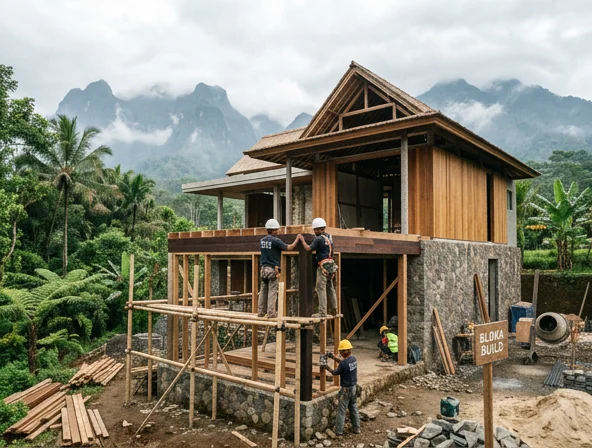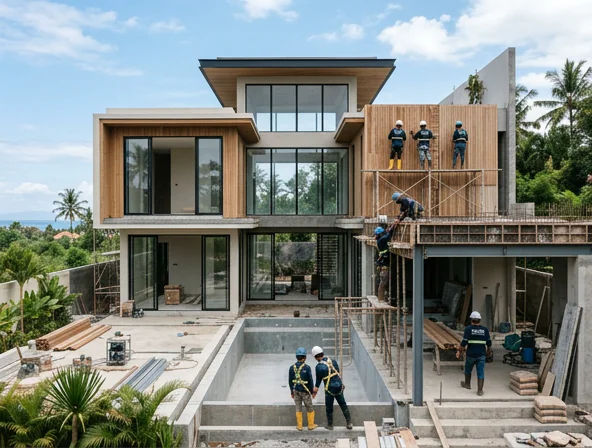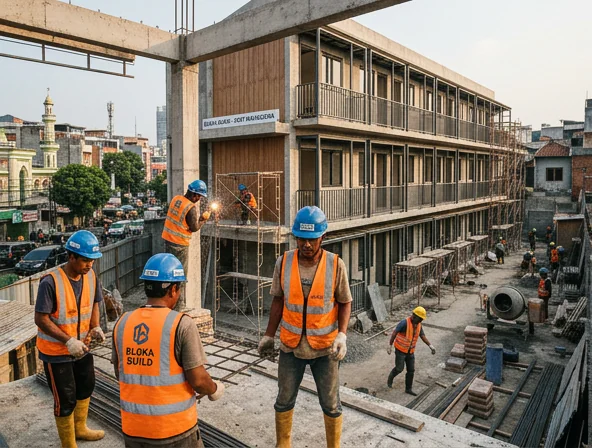

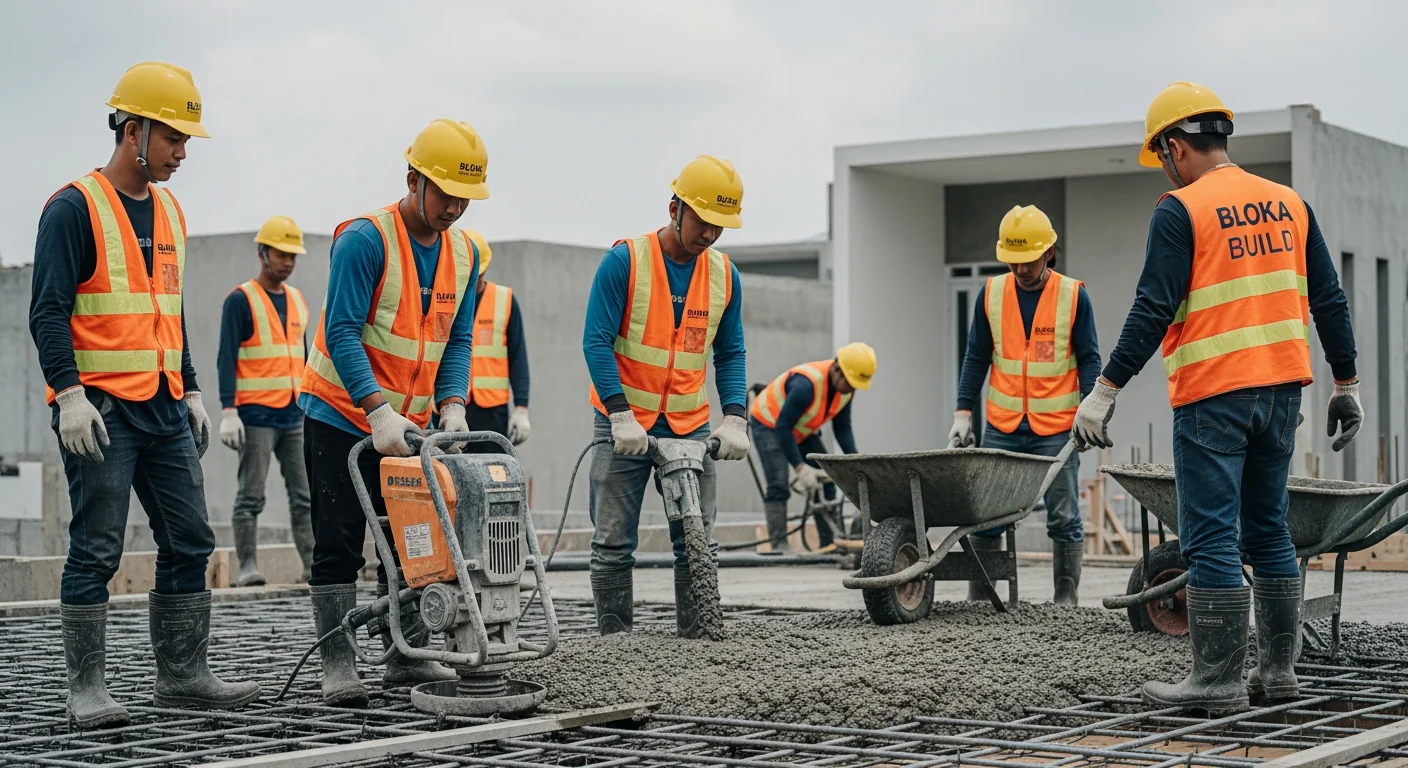
The standard size of river stone foundations for houses is the main foundation—literally—in every sturdy and long-lasting building project.
Think of this foundation like the roots of a giant tree that support the entire weight of your house, preventing it from cracking or collapsing when heavy rain or an earthquake strikes.
At Bloka Build, as an experienced contractor, we often see homeowners who initially overlook this detail, only to regret it later as repair costs skyrocket.
This article will thoroughly discuss standard dimensions, application tips, and why choosing a partner like us for home building or renovation services can save you time and money. Let's dive in and get your dream home built without the hassle.
Understanding River Rock Foundations as an Economical and Strong Option for Residential Buildings
A river rock foundation isn't just a random pile of rocks; it's a simple yet robust foundation system that's popular in Indonesia, especially for 1-2 story homes in areas with stable soil like Palembang and its surroundings.
Made from natural river stones neatly arranged with a mixture of cement and sand, this foundation offers high compressive strength while remaining budget-friendly—ideal for those of you who are planning a new home construction service or an old home renovation service.
The standard size of river stone foundations for houses usually follows the SNI 2847:2019 guidelines regarding structural concrete requirements, which emphasizes the proportions of width, height, and depth to be able to withstand vertical loads of up to 100-200 kN per square meter.
Why is this foundation so popular? First, it's 30-50% cheaper than reinforced concrete foundations for small homes.
Second, installation is fast, only taking 3-7 days for a 100 m² house foundation, suitable for contractors who want to be efficient.
Imagine you're adding a room to your house—the river rock foundation can be adjusted without re-digging the entire plot.
At Bloka Build, we have completed hundreds of projects like this, from bathroom renovation services to boarding house and shophouse contractors, always ensuring these foundations meet standards so that the building will last for more than 50 years.
Don't make a mistake with your measurements; a foundation that isn't deep enough can cause the house to lean, while one that's too wide can waste materials. Let's discuss the detailed measurements next.
Standard Width and Height of River Rock Foundations That Homeowners Must Know
When talking about the standard size of river stone foundations for houses, the width of the foundation is the first crucial factor that you must consider.
For standard homes with light loads (tile roofs, brick walls), the foundation width is typically 60-80 cm. This is sufficient to distribute the load to the ground and prevent differential settlement that can cause floor cracks.
If your house has 2 floors or is on soft ground, raise it to 80-100 cm—according to the recommendations of structural experts from home architectural services.
Height? Standard 40-60 cm above ground level, with the bottom buried 80-120 cm into the ground, depending on the depth of the rainy season in your area.
Have you ever seen an old house that's leaning? That's often because the foundation is only 40 cm wide, far below standard.
In our home improvement projects, we often upgrade foundations like this for safety. The materials?
Use river stones with a diameter of 15-25 cm, arranged in a hollow space and filled with a 1:4 cement-sand mortar. Space the stones at least 2 cm apart for optimal strength. For modern homes, combine with wooden formwork for a neat shape.
With this size, the foundation can withstand earthquakes up to magnitude 6, as proven in our specialized facility contractor projects. The compelling reason is that investing in the right size today saves the cost of kitchen renovations or adding a bedroom tomorrow.
Ideal Depth and Excavation for River Rock Foundations According to Local Soil Conditions
Depth is the lifeblood of the standard size of river stone foundations for houses, because the ground underneath must be stable.
In hard soils like laterite in Central Java, dig a minimum of 80 cm; for clay or sandy soils, lower the foundation to a hard layer of 120-150 cm. This prevents the foundation from sinking during the rainy season, a frequent problem in Palembang.
SNI standards recommend a minimum depth of 1 meter for earthquake-prone zones, with foundation footings widened 20 cm at the bottom for a 'shoe' effect.
Think of a foundation as the foundation of a career—if it's shallow, it's easily shaken. In Bloka Build's experience as an office contractor, we always perform a simple soil test: dig a 2x2 meter hole, fill it with water, and measure the absorption. If the soil is wet for more than 24 hours, add 30 cm to the depth and install geotextiles.
For commercial fit out services, This measurement is adjusted to align with the superstructure. The result? Your home will not only be sturdy, but will also increase its value by 20% when you sell it. Relax, our team is ready to assist with a free survey.
Factors Determining the Adjustment of the Size of the River Rock Foundation Based on the Load and Design of the House
There's no one-size-fits-all standard for river rock foundation sizes for homes; it all depends on the structural load. A 36 m² single-story house?
A width of 60 cm is sufficient. Adding a floor or pool? Increase it to 90 cm with 10 mm diameter vertical steel reinforcement every 30 cm.
A tropical house design with a sloping roof requires a 20 cm deeper foundation due to strong winds. In our home renovation project, we calculated the total load: walls 15 kN/m, roof 10 kN/m, then divided it evenly across the foundation.
Another factor: the local climate. Palembang has high rainfall? Add drainage to the sides of the foundation to prevent water erosion.
For contractors like us, simple software like ETABS helps with simulations. The key is to avoid guesswork; consulting with Bloka Build's architectural services ensures precise measurements and saves 15% on materials. The end result: a comfortable home to live in for decades.
Step by Step Guide to Installing a Standard Size River Rock Foundation for Maximum Results
Whether you want to do it yourself or use a service, follow these steps for standard river rock foundation sizes for your home.
First, mark the foundation line with stakes and string, according to the plans provided by the home architect. Dig to the specified depth, level the base, and add 10 cm of backfill sand and compact it.
Lay the river stones layer by layer, pour mortar over them, and fill the holes tightly. Let them dry for three days before pouring a 10 cm thick foundation cap with K225 concrete.
Second, install woven bamboo or iron gabions for fastening. Third, check the plumb bob to ensure it's perfectly vertical.
At Bloka Build, we perform this process for bathroom renovations and boarding house and shophouse contractors with zero defects. Relaxed yet professional—our team uses a laser level for millimeter accuracy.
Common Mistakes in Sizing River Rock Foundations and How to Avoid Them with a Professional Contractor
Avoid these pitfalls when applying standard dimensions for river rock foundations to your home. The first mistake: measuring too narrowly, which can cause the foundation to sink.
Solution: Double-check with the load formula q = P/A (q = soil pressure, P = load, A = foundation area). Second: thin mortar, loose stone. Use a 1:3 ratio for strength. Third: ignore drainage, foundation flooding.
In our home improvement projects, 70% cases were caused by this. Choose a licensed contractor like Bloka Build, and the problem is solved. We guarantee 100% satisfaction.
Long-Term Benefits of Adhering to Foundation Size Standards for Your Home Investment
Complying with the standard size of river stone foundations for homes means your home is earthquake-resistant, has minimal cracks, and increases property value.
Save up to 40% on maintenance costs, plus peace of mind. Our home building experience shows that clients are satisfied with this foundation's flexibility for future additions or commercial fit-out services.
Ready to build or renovate your dream home with the highest standard river stone foundation? Contact Bloka Build now for a free consultation on contractor services in Palembang and the surrounding areas.